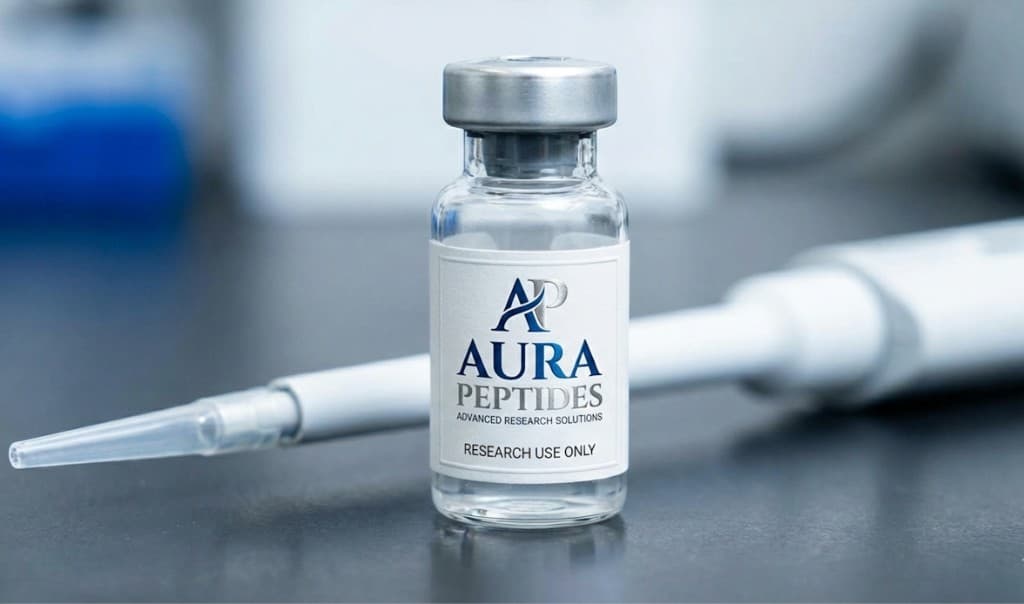
TB-500
$129.99
A synthetic 43-amino-acid peptide identical to the active region of Thymosin Beta-4, a naturally occurring protein involved in cell migration, blood vessel formation, and tissue repair. TB-500 has shown anti-inflammatory and anti-fibrotic properties across multiple research models.
Certificate of Analysis
Third-party verified · HPLC & Mass Spectrometry
Purity
98.74%
Lot Number
AUR-TB500-250115
Test Date
Jan 15, 2025
Laboratory
Janssen Analytik GmbH
Compound Details
Mechanism of Action
Sequesters G-actin monomers to regulate actin polymerization, promoting cell migration and wound closure. Upregulates cell-surface integrins and metalloproteinases. Exhibits anti-inflammatory activity by suppressing NF-κB-mediated cytokine release.
Molecular Profile
- Molecular Weight
- 4,963.50 Da
- Sequence
- Ac-SDKP active region (43 amino acids)
- Purity Spec
- ≥98% by HPLC
Storage
Store lyophilized at −20°C. Reconstituted: 2–8°C, use within 30 days. Protect from light.
Research Applications
Published Research
Peer-reviewed studies from PubMed.
Inhaled thymosin β4 suppressed bleomycin-induced pulmonary fibrosis in mice by downregulating the TGF-β1/Smad signaling pathway, demonstrating a novel delivery route and therapeutic application beyond wound healing.
- Inhaled Tβ4 significantly reduced lung fibrosis scores in bleomycin model
- Mechanism involves suppression of TGF-β1/Smad signaling cascade
- First evidence supporting inhaled delivery of Tβ4 for pulmonary fibrosis
- Simultaneous quantification of TB-500 and its metabolites: screening by wound healing activities in vitro2024Pharmacology
Advanced mass spectrometry study revealing that TB-500’s wound-healing activity resides primarily in its metabolite Ac-LKKTE rather than the parent peptide — a key finding for understanding its mechanism of action.
- TB-500 metabolite Ac-LKKTE showed significant wound-healing activity, while the parent peptide did not
- Ac-LK identified as the primary short-term metabolite; Ac-LKK persists up to 72 hours
- No cytotoxicity observed from TB-500 or any of its metabolites
- Thymosin β4 promotes dermal healing2016Wound Healing
Thymosin β4 (Tβ4) accelerates dermal wound repair with angiogenic and anti-inflammatory activity; relevant to skin and tissue repair research.
- Accelerated wound closure rate compared to controls
- Stimulated angiogenesis in the wound bed
- Reduced inflammatory cell infiltration at injury sites
- Thymosin beta4 accelerates wound healing1999Wound Healing
Foundational study demonstrating that thymosin β4 significantly accelerates dermal wound healing in both normal and steroid-impaired animal models.
- First evidence of Tβ4 as a wound healing promoter
- Effective even in steroid-impaired (immunocompromised) healing models
- Increased keratinocyte migration in scratch-wound assay
- Thymosin β4 and its degradation product, Ac-SDKP, are novel reparative factors in renal fibrosis2010Anti-Fibrotic
Tβ4 and its cleavage product Ac-SDKP reduce renal fibrosis by suppressing TGF-β/Smad signaling, demonstrating anti-fibrotic potential beyond dermal wound repair.
- Both Tβ4 and Ac-SDKP significantly reduced renal fibrosis
- Mechanism involves suppression of TGF-β/Smad3 signaling pathway
- Suggests therapeutic potential for organ fibrosis beyond skin
- Roles of thymosin β4 in cardioprotection and repair following myocardial infarction2012Cardiovascular
Review of Tβ4 in cardiac repair: activates epicardial progenitor cells, promotes neovascularization, and improves cardiac function post-myocardial infarction in murine models.
- Activated epicardial progenitor cells to form new cardiomyocytes
- Improved cardiac function and reduced scar size after infarction
- Promoted coronary neovascularization in ischemic tissue