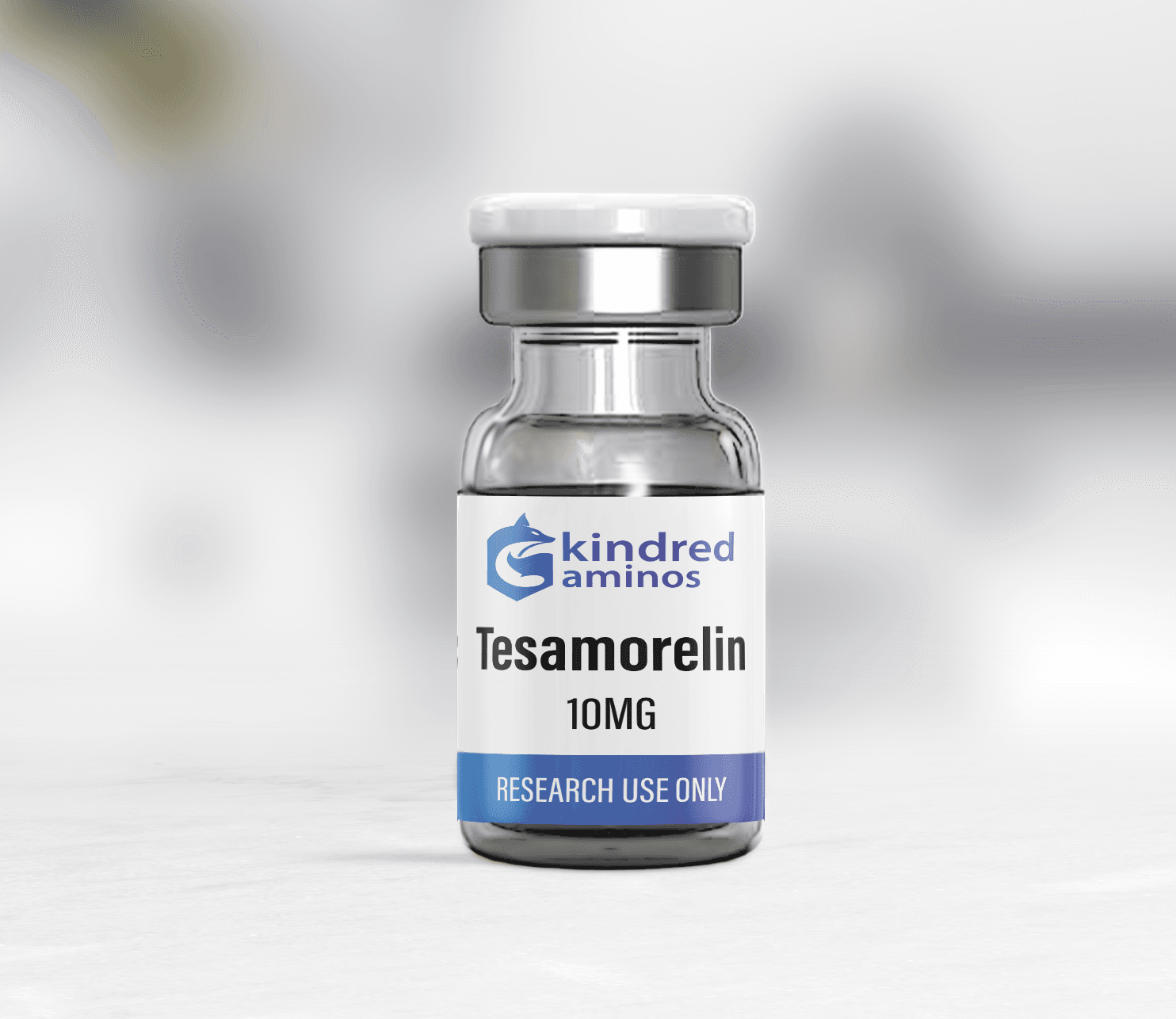
Tesamorelin
Select Size
$79.99
A synthetic 44-amino-acid analog of human growth hormone-releasing hormone (GHRH) with an N-terminal trans-3-hexenoic acid modification that confers resistance to enzymatic degradation. Tesamorelin stimulates pulsatile endogenous growth hormone secretion via the GHRH receptor, making it a research tool for investigating GH/IGF-1 axis biology, visceral adiposity, and hepatic lipid metabolism.
Certificate of Analysis
Third-party verified · HPLC & Mass Spectrometry
Purity
99.16%
Search Code
Alph2602150141
Test Date
Feb 17, 2026
Laboratory
Freedom Diagnostics
Compound Details
Mechanism of Action
Binds and activates pituitary GHRH receptors, triggering Gsα-coupled cAMP/PKA signaling that stimulates pulsatile growth hormone release. The resulting GH elevation increases hepatic IGF-1 production, which mediates downstream lipolysis (particularly visceral fat), lean mass preservation, and upregulation of mitochondrial oxidative phosphorylation genes. Unlike exogenous GH, tesamorelin preserves the hypothalamic feedback loop and physiological GH pulsatility.
Molecular Profile
- Molecular Weight
- 5,135.86 Da
- Sequence
- 44 amino acids (modified GHRH(1–44) with N-terminal trans-3-hexenoic acid)
- Purity Spec
- ≥98% by HPLC
Storage
Store lyophilized at −20°C. Reconstituted: 2–8°C, use within 14 days. Sensitive to proteolytic degradation — avoid repeated freeze-thaw cycles.
Research Applications
Published Research
Peer-reviewed studies from PubMed.
Meta-analysis of five RCTs: tesamorelin significantly reduced visceral adipose tissue (−27.71 cm²), hepatic fat (−4.28%), and waist circumference (−1.61 cm) while increasing lean body mass by 1.42 kg. No serious safety concerns across pooled data.
- Visceral fat reduced by 27.71 cm² across five pooled RCTs (P<0.001)
- Hepatic fat fraction decreased by 4.28% (P<0.001)
- Lean body mass increased by 1.42 kg with no serious adverse events
- Effects of tesamorelin on neurocognitive impairment in persons with HIV and abdominal obesity2025Neurocognitive
Phase 2 RCT examining tesamorelin’s effects on neurocognition in virally suppressed HIV patients with abdominal obesity. Significant waist circumference reduction (−2.7 cm) and a trend toward improved neurocognitive performance, though primary cognitive endpoint did not reach statistical significance.
- Significant waist circumference reduction of 2.7 cm vs standard care
- Trend toward improved neurocognitive composite scores
- Suggests potential CNS effects of GH/IGF-1 axis modulation
Landmark Lancet HIV trial: tesamorelin significantly reduced hepatic fat fraction over 12 months in HIV patients with NAFLD — the first demonstrated pharmacological treatment for NAFLD in this population.
- Significant reduction in hepatic fat fraction vs placebo at 12 months
- First proven pharmacological treatment for NAFLD in HIV-positive patients
- Benefits maintained during 6-month open-label extension phase
- Effect of tesamorelin on visceral fat and liver fat in HIV-infected patients with abdominal fat accumulation: a randomized clinical trial2014Body Composition
JAMA-published RCT: tesamorelin reduced visceral adipose tissue by 34 cm² (vs +8 cm² placebo) and liver fat by 2.0% over 6 months, demonstrating selective visceral lipolysis without affecting subcutaneous fat stores.
- Visceral fat reduced by 34 cm² vs 8 cm² increase with placebo
- Liver fat reduced by 2.0% with a net treatment effect of −2.9%
- Selective visceral lipolysis — subcutaneous fat was not significantly affected
- Tesamorelin, a human growth hormone releasing factor analogue: pharmacology and clinical utility2009Review
Comprehensive pharmacology review of tesamorelin: mechanism of GHRH receptor activation, the role of the trans-3-hexenoic acid modification in enzymatic resistance, pharmacokinetics, and clinical evidence for visceral fat reduction.
- N-terminal hexenoic acid modification confers resistance to DPP-IV and neutral endopeptidase
- Preserves physiological pulsatile GH secretion unlike exogenous GH
- Dose-dependent visceral fat reduction with preserved lean body mass