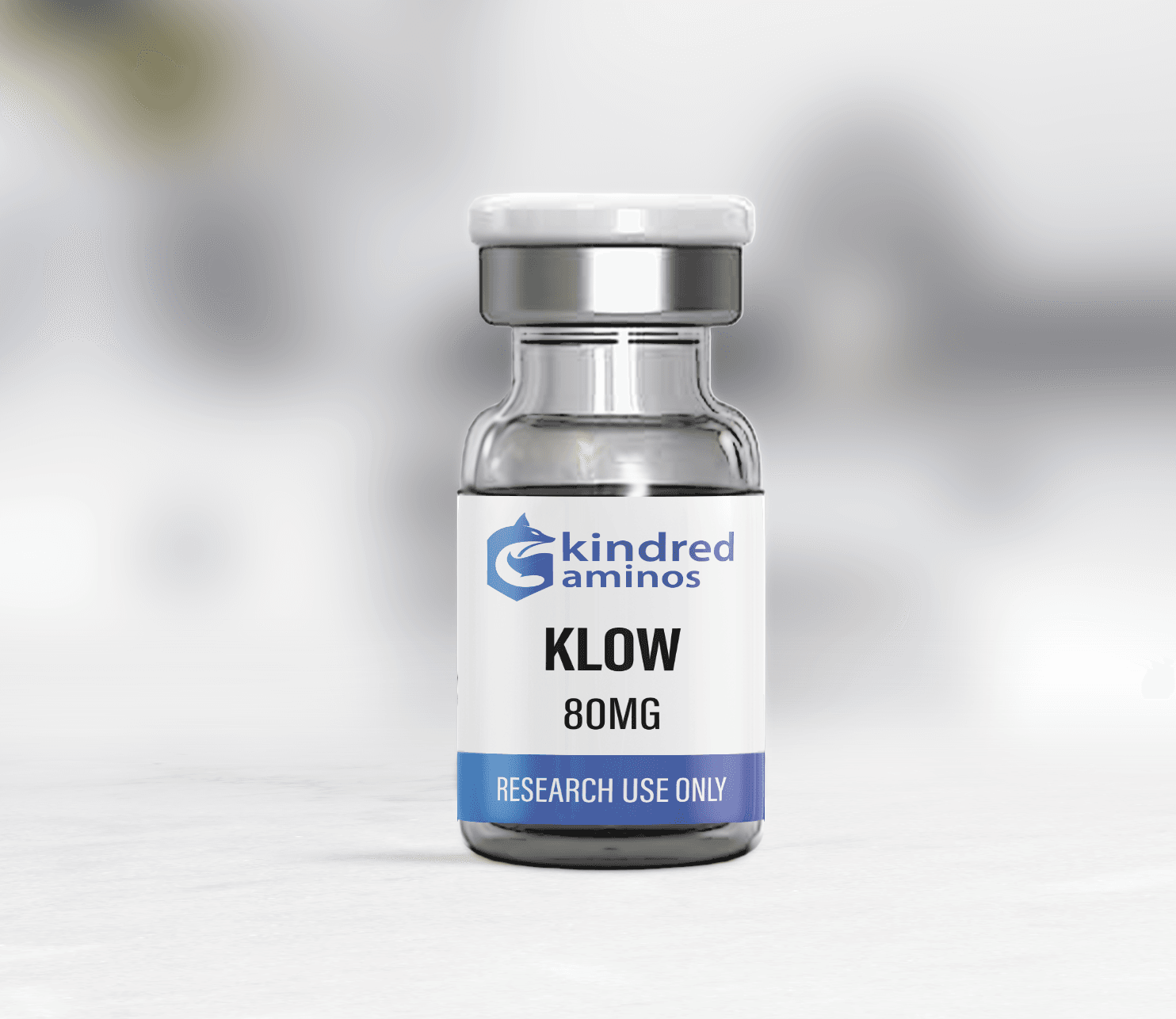
K-Glow
Select Size
$129.99
Four research-backed peptides targeting complementary pathways — inflammation, matrix rebuilding, vascularization, and tissue repair — for a multi-mechanism approach to skin and tissue research.
Certificate of Analysis
Third-party verified · HPLC & Mass Spectrometry
Purity
99.6093%
Search Code
Coff2601150048
Test Date
Jan 18, 2026
Laboratory
Freedom Diagnostics
Composition
What's in this blend — peptide by peptide.
Total blend: 80mg
KPV
10mgAnti-inflammatory tripeptide derived from alpha-MSH. Inhibits IL-1β and NF-κB pathways to reduce immune-driven skin irritation.
GHK-Cu 5000
50mgCopper-bound tripeptide that stimulates collagen, elastin, and glycosaminoglycan synthesis. Promotes fibroblast activity and antioxidant protection against UV and free-radical damage.
BPC-157
10mgGastric pentadecapeptide that promotes angiogenesis via VEGF/VEGFR2, accelerates wound closure, and enhances collagen deposition and re-epithelialization.
TB-500
10mgSynthetic fragment of Thymosin Beta-4. Anti-inflammatory and anti-fibrotic; promotes cell migration and supports all phases of dermal wound repair.
Published Research
Peer-reviewed studies from PubMed.
KPV Research
Research-only component- Melanocortin-derived tripeptide KPV has anti-inflammatory effects
Experimental work demonstrates that the alpha-MSH-derived tripeptide KPV exerts anti-inflammatory activity in intestinal epithelial and immune models, with pathway-level reductions in pro-inflammatory signaling.
- PepT1-mediated tripeptide KPV uptake reduces intestinal inflammation
Study shows that PepT1 transporter-mediated uptake of KPV is linked to reduced intestinal inflammation in preclinical models, supporting an epithelial uptake mechanism for local anti-inflammatory action.
- PepT1 deletion in mice suppresses colitis-associated cancer and alters the tumor immune microenvironment
Research in PepT1-deficient models explores intestinal inflammation and tumor microenvironment signaling, and includes KPV-related transporter-pathway context relevant to inflammatory bowel disease and colitis-associated carcinogenesis.
GHK-Cu 5000 Research
View GHK-Cu 5000 page →- Exploring the beneficial effects of GHK-Cu on an experimental model of colitis and the underlying mechanisms
GHK-Cu demonstrated significant anti-inflammatory and protective effects in an experimental colitis model, extending its known tissue-repair properties to gastrointestinal inflammation and mucosal healing.
- Effects of topical copper tripeptide complex on wound healing in an irradiated rat model
Evaluates topical GHK-Cu on irradiated rat dorsal flaps; reports increased vascularization and VEGF expression in a compromised wound-healing model.
- The human tri-peptide GHK and tissue remodeling
Comprehensive review of GHK and GHK-Cu: stimulation of collagen, elastin, and connective tissue accumulation; broad relevance to wound healing, skin repair, and tissue remodeling.
BPC-157 Research
View BPC-157 page →- Stable gastric pentadecapeptide BPC 157 as therapy after surgical detachment of the quadriceps muscle for muscle-to-bone reattachment in rats
BPC 157 promoted quadriceps muscle-to-bone reattachment after surgical detachment in rats, with consistent healing confirmed via ultrasonic, MRI, biomechanical, and functional assessments. Walking patterns normalized and leg contracture was eliminated within 3 months.
- Stable gastric pentadecapeptide BPC 157: novel therapy in gastrointestinal tract
Comprehensive review of BPC 157 as a novel therapy for gastrointestinal tract conditions, with pleiotropic beneficial activity and no reported toxicity across numerous experimental models.
- The promoting effect of pentadecapeptide BPC 157 on tendon healing involves tendon outgrowth, cell survival, and cell migration
BPC 157 accelerates healing of transected rat Achilles tendon and stimulates tendocyte growth in vitro; the effect involves tendon outgrowth, cell survival, and cell migration.
TB-500 Research
Research-only component- Inhaled exogenous thymosin beta 4 suppresses bleomycin-induced pulmonary fibrosis in mice via TGF-β1 signalling pathway
Inhaled thymosin β4 suppressed bleomycin-induced pulmonary fibrosis in mice by downregulating the TGF-β1/Smad signaling pathway, demonstrating a novel delivery route and therapeutic application beyond wound healing.
- Simultaneous quantification of TB-500 and its metabolites: screening by wound healing activities in vitro
Advanced mass spectrometry study revealing that TB-500’s wound-healing activity resides primarily in its metabolite Ac-LKKTE rather than the parent peptide — a key finding for understanding its mechanism of action.
- Thymosin β4 promotes dermal healing
Thymosin β4 (Tβ4) accelerates dermal wound repair with angiogenic and anti-inflammatory activity; relevant to skin and tissue repair research.